
The Fields Behind Habersham County Property Tax Records
Habersham County property tax records are a two-office record set. The Board of Tax Assessors establishes fair market value as of January 1, applies the statutory assessment ratio, and administers exemptions. The Tax Commissioner turns the approved digest into bills, accepts payment, and administers delinquency. These fields answer different questions and should remain separate.
| Field | What It Shows | Where |
|---|---|---|
| Fair market value | The assessor's estimate of full value as of January 1 | Tax Assessors |
| Assessed value | Generally 40% of fair market value before exemptions | Tax Assessors |
| Exemptions | Homestead and other approved reductions | Tax Assessors |
| Annual bill | Levy, amount due, payment and delinquency status | Tax Commissioner |
| FiFa or tax sale | Collection action for an unpaid obligation | Tax Commissioner and recorded notices |
Georgia's Department of Revenue lays out the arithmetic plainly: fair market value multiplied by 40 percent yields assessed value before exemptions. Millage is then applied to whatever taxable assessment remains. Neither the resulting bill nor a recorded sale price can stand in for the assessor's fair market value figure on the parcel.
Habersham's January-to-November Tax Calendar
The county's assessment timeline runs on a January 1 valuation date. Property owners may file returns from January 1 through April 1. Assessment notices follow during digest preparation. A notice opens the appeal window. After the state approves the digest, bills generally go out from August through November. They come due November 15. That sequence explains why dates can differ. A deed, an assessment year, and the current tax bill can each carry a different date for the same Habersham County parcel.
| Stage | Record to retain | Why it matters |
|---|---|---|
| January 1 | Ownership and condition snapshot | Controls the valuation date |
| January 1-April 1 | Return and exemption filing | Allows corrections and eligible claims |
| Notice period | Assessment notice | Starts the 45-day appeal clock |
| August-November | Tax bill | Shows the levy after digest approval |
| November 15 | Payment receipt | Documents timely payment |
Note: The assessment notice is not the tax bill; each comes from a different Habersham County office and serves a different purpose.
How Georgia's 40 Percent Assessment Works
The Georgia valuation guidance sets a simple rule. Taxable property is assessed at 40 percent of fair market value. Picture a $200,000 home; the assessed value would be $80,000 before exemptions. That illustration fits no actual Habersham County parcel. The final bill depends on which exemptions apply and on the millage each jurisdiction adopts.
- Fair market value
- The assessor's estimate of the amount property would bring in an arm's-length sale.
- Assessed value
- The statutory percentage of fair market value used before exemptions.
- Millage or levy
- The rate applied to taxable assessed value to calculate tax.
- Homestead exemption
- An approved reduction for a qualifying primary residence.
- Tax lien or FiFa
- A collection claim tied to an unpaid tax obligation.
For a real parcel, keep fair market, assessed, exempt, and taxable values on separate lines. The worksheet then shows the cause of any change. A difference may trace to the appraisal, the statutory ratio, an exemption, or the levy rather than to a single culprit.
Use qPublic, Then Keep an Office Fallback
Habersham County points property researchers to its qPublic landing page. It also offers a separate property search application. The live application can present an access challenge. Never guess at a search form. Enter one known item, such as a street address, owner name, or parcel number. If the online route stalls, call the assessor at 706-839-0100 or visit the county office in person.
The assessor tracks ownership changes, parcel boundaries, zoning use, property characteristics, exemptions, and sales trends. Its roll is therefore the place to understand an appraisal. Meanwhile, the newest deed in the deed records remains the best confirmation of a recent ownership transfer.
When qPublic itself is blocked, the official Tax Assessor page is the dependable starting point. Open the county's Tax Assessor source page for office contacts and service links.
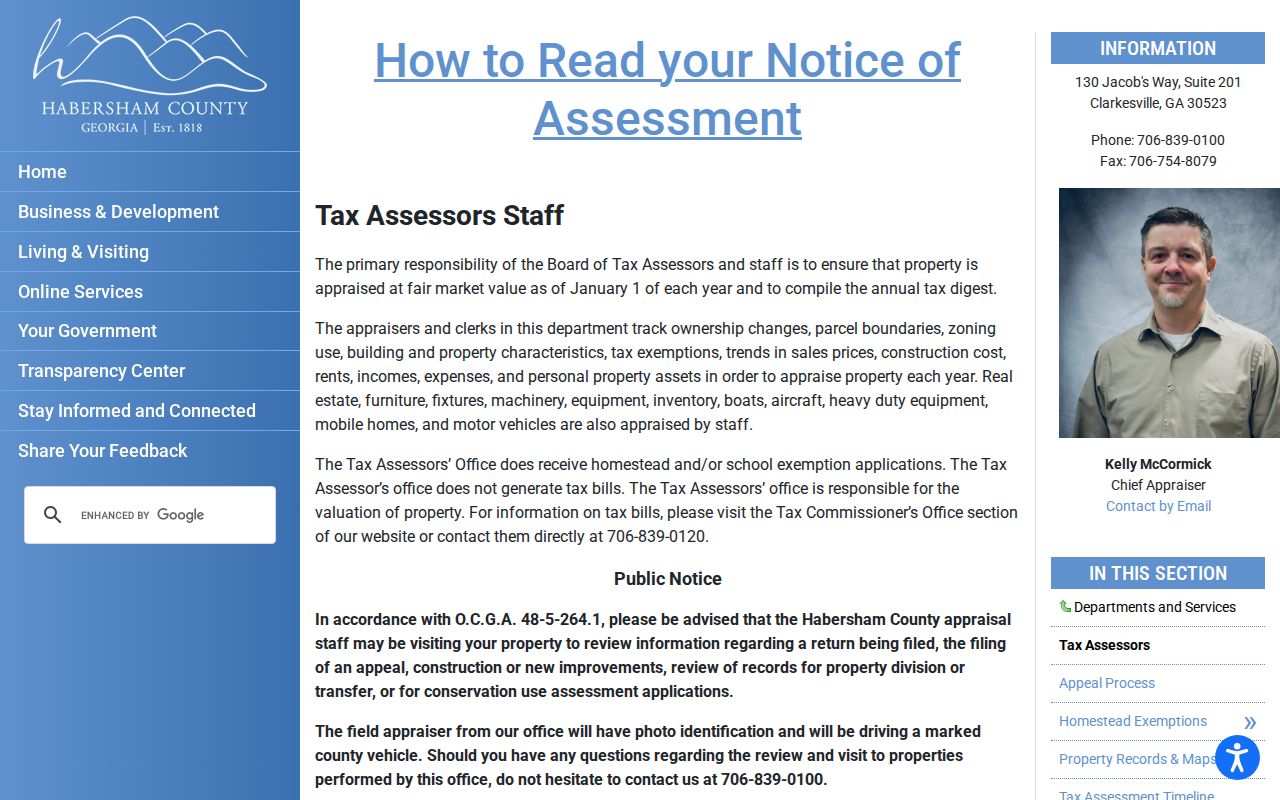
The assessor's published duties draw a clean line. Appraisal and exemption questions belong with that office, while billing and payment questions go to the Tax Commissioner.
Look Up a Habersham County Tax Bill
The county tax search and payment page is the online route to a Habersham County tax bill. County guidance says to enter just one search variable at a time. A last name works as an example. Carry the parcel number over from the assessor record whenever possible. Check the tax year too. A balance means nothing until you confirm which year it covers.
- Open the assessor record and copy the parcel number exactly, including any leading zero or letter.
- Search the Tax Commissioner's page with one variable and select the correct tax year.
- Compare the bill against the assessor's value and exemptions rather than assuming the payment screen contains appraisal detail.
- Retain the receipt or note the status, then contact the office about any delinquency, FiFa, or tax-sale notation.
- Assessed value
- The 40-percent value before eligible exemptions are deducted.
- Mill rate / levy
- The adopted rate applied to taxable assessed value.
- Homestead exemption
- Primary-residence relief approved through the assessor.
- Tax lien
- A legal collection claim for unpaid property tax.
When the verification screen or payment service fails, the Tax Commissioner counter sits at 130 Jacobs Way, Suite 202, in Clarkesville. Call 706-839-0120, or visit Monday through Friday from 8:00 a.m. to 4:45 p.m. Before sending funds, ask the office to confirm the year, principal, interest, penalties, collection status, and accepted payment methods.
Habersham Homestead and Income-Based Exemptions
The county's homestead exemption page walks through local and state codes. It also explains eligibility, filing, and automatic renewal. A separate income-based exemption page covers EL2 and EL3 school or disability provisions. It also details audit requirements. Match the code printed on the assessment record to the program actually approved. A drop in taxable value does not mean the county lowered fair market value. The county lowered the taxable figure by the same amount.
File with the Tax Assessors during the stated period. Bring the documentation the county specifies. Do not count on a prior owner's exemption. Eligibility, not the parcel alone, governs whether an exemption continues.
A Ten-Year CUVA Covenant Can Distort Comparisons
The county's Conservation Use Valuation Assessment guidance describes a ten-year covenant. It values qualifying land by its current use. After HB 916, no blanket minimum-acreage rule applies. Agricultural proof can still be required for tracts under ten acres. Residence acreage may sit outside current-use treatment. Breaching the covenant improperly can trigger a penalty.
A Habersham County tax figure that looks oddly low beside an ordinary residential parcel may simply carry CUVA treatment. Check for the covenant before reading the number as market value. Read the covenant terms, acreage treatment, and breach provisions together with the assessment.
FiFa Is Not the Same as Current Record Ownership
Notices tied to delinquent taxes use two labels that mean different things. "Defendant in Fi-Fa" points to the party tied to the unpaid obligation. "Current Record Holder" is separate. It shows the owner of record as the notice frames it. Habersham County publishes these terms across its sale notices. The county's tax and fee guidance covers the surrounding ground: interest, penalties, FiFa, certification, and tax-sale administration. Read both labels carefully. That keeps a FiFa entry from being mistaken for a change in ownership on the deed records.
Read the original notice. A delinquency name, tax-bill name, and latest deed grantee may not match; verify each against its date and source.
Before acting on a sale or redemption, get the numbers from the source. Ask the Tax Commissioner for the current payoff and sale status. Then check the Clerk's recorded instruments on the deed side. A tax-search result alone settles neither title nor the legal effect of a sale.
Request Missing Habersham Tax Material Precisely
Some assessment worksheets and older digest entries never make it online. Ask the responsible office first. When county records exist but stay out of reach, the Georgia Open Records request route takes the county form, email to boc_records@habershamga.com, or mail. Habersham County promises an initial response within three business days. Copies run $0.10 per page. Search and retrieval are free for the first 15 minutes. Lawful labor, media, or postage costs may follow.
Write the request narrowly. Name the parcel, the tax year, the document type, and the format you want. That beats asking for "all tax records." Assessment files and collection files sit with different custodians in Habersham County.
Appeal a Habersham County Assessment on Time
Habersham County gives you 45 days from the assessment notice date to appeal. File in writing or on a PT-311A under the county appeal process. The grounds can vary. They may include value and uniformity. Taxability, exemption denial, or breach of a conservation covenant also qualify. Keep the notice envelope. Submit parcel-specific evidence: comparable sales, photographs, measurements, repair estimates, or a professional appraisal.
From there the appeal can move through the Board of Equalization. A hearing officer or arbitration may apply where published rules allow. The Board of Equalization page details its jurisdiction, hearing representation, and the route to Superior Court. One limit matters. An appeal attacks the assessment only. It does not touch the annual millage or a deed's ownership statement in the property records.
Appeal window. File within 45 days of the date printed on the assessment notice. The deadline is notice-specific, not a universal calendar date.
The county's own appeals page carries the official filing route, and forms there can change. Check the current Habersham appeals page before submitting anything.
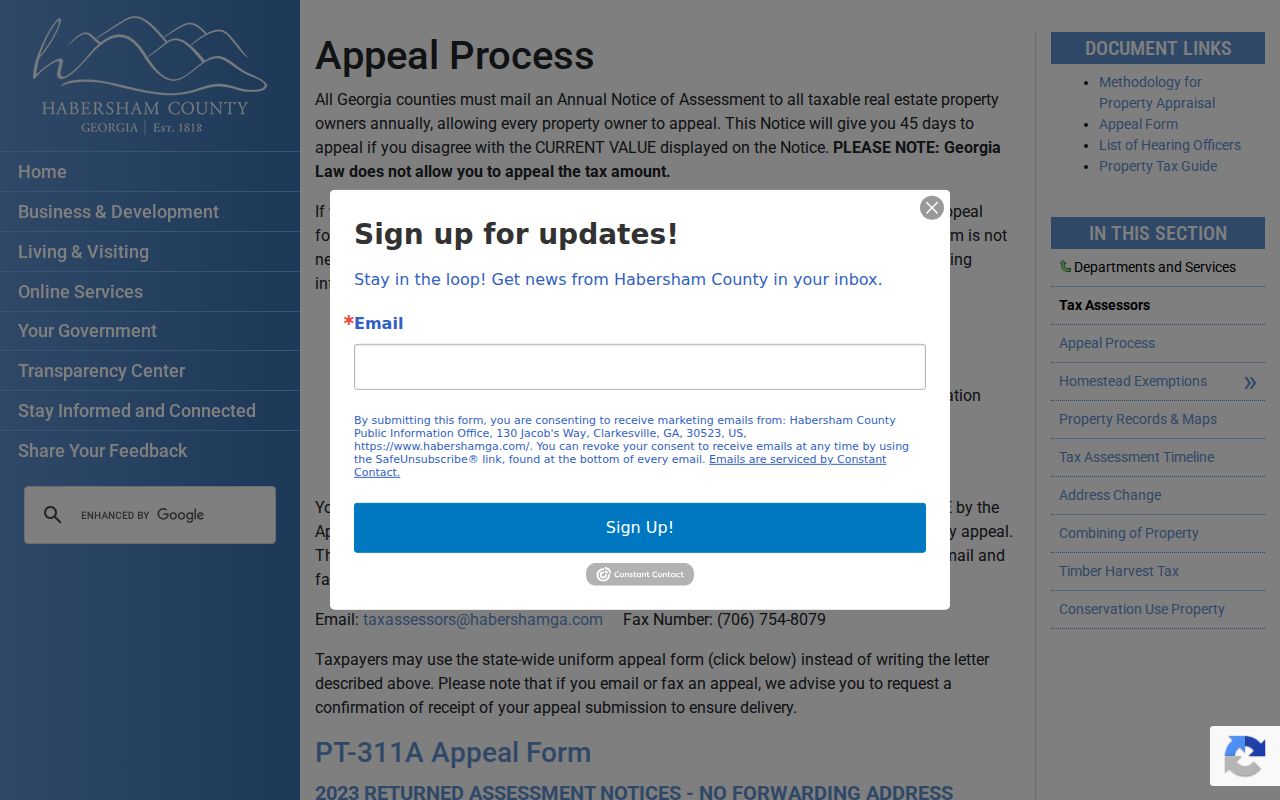
Treat the live page and the date printed on your actual notice as the controlling instructions. Then keep proof that your appeal arrived on time.